Latest News

2016 Nissan Maxima Cold Air Intake by AEM Improves Horsepower while Protecting Engine

Caption

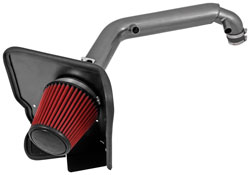
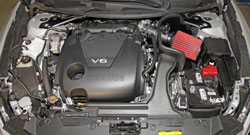
The AEM 21-793C cold air intake system includes three stainless steel clamps and low restriction mandrel-bent aluminum tubing with a durable gunmetal gray powder coated finish.

he AEM 21-793C air intake system is specifically designed and engineered for the 2016 front-wheel drive Nissan Maxima with the 3.5-liter V6 engine. The engine is mated to a revised continuously variable automatic transmission (CVT) that has Sport and Manual Modes. It comes in five trim levels – the base S, SL, SR, SV, and Platinum – with a plethora of safety features including blind spot warning, forward collision warning, and forward emergency braking. Driver attention alert, around view monitor, adaptive cruise control, and moving object detection is available only on the Platinum trim.

Caption

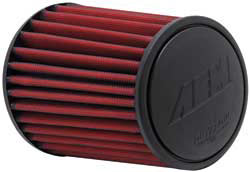
Included in the intake system is the AEM 21-2113DK DryFlow air filter that captures and holds up to 99% of harmful containments.

The S trim includes charcoal or cashmere cloth upholstery as standard. Charcoal or cashmere leather upholstery comes standard on the SV, SL, and Platinum. The SR includes leather upholstery with charcoal or camel Alcantara inserts. The SV trim includes leather seats, heated front seats, front and rear parking sensors, driver's seat power lumbar support, and driver's seat thigh support.

The SL includes what is in the SV, but also includes a Bose premium audio system, blind spot warning, forward collision warning, adaptive cruise control and panoramic moon roof. The SR does not include the moonroof, but adds a sports-tuned suspension, 19-inch wheels, premium Ascot leather with diamond-quilted Alcantara inserts, and an integrated dynamics control module, which adds active ride control and active engine brake to enhance ride and handling.

Central control is very convenient to use. For example, control of the basic audio system can be performed with knobs on the radio faceplate, from a central control knob on the console, or redundant controls on the steering wheel. The system also includes a touchscreen on which menu choices are displayed.

Caption

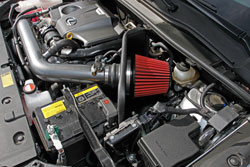
The system provides a professional look when installed in your 2016 Nissan Maxima.

The Platinum trim includes a 360° camera system, which is ideal in assisting the driver to park the vehicle. The moving-object detection (MOD) warns the driver of cars, bikes, and pedestrians who may be approaching the vehicle from any direction. Driver attention alert (DAA) monitors steering movements and sounds a warning if steering gets erratic, which may occur when he or she becomes drowsy.

The AEM 21-793C cold air intake is specifically designed and engineered for the 2016 Nissan Maxima. The system includes a DRYFLOW air filter that features a synthetic filter media with no oil required and a thick third media to help increase airflow and achieve higher capacity. The filter is washable and reusable and can be used for up to 100,000 miles before cleaning is necessary, based on driving conditions.

AEM also offers a synthetic air filter cleaner that is specially formulated to loosen and dissolve dirt and grime from the filter so that they can be easily rinsed with water.

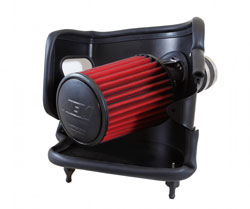
The cold air intake system is designed and constructed to permit air to enter through the air filter for better airflow, filtration, and performance. The air filter fits into the factory air box space and is protected with a heat shield that reduces intake air temperature to help increase horsepower. The entire system can be easily installed using common hand tools and it is backed with an AEM Lifetime Limited Warranty.

The AEM 21-793C Cold Air Intake System is designed and engineered to fit the following vehicle:

2016 Nissan Maxima 3.5L V6

You can view all the air intakes that AEM makes for the Nissan Maxima at the Air Intake Systems for the Nissan Maxima page and all the air filters that AEM makes for the Nissan Maxima at the Air Filters for the Nissan Maxima page. You can view all the AEM performance products for any vehicle by using the Search by Vehicle tool and you can find a local AEM retailer by plugging your location into the AEM Dealer Search as well.

The Turbocharged Hyundai Tucson Gets Added Potential with AEM Charge Pipes

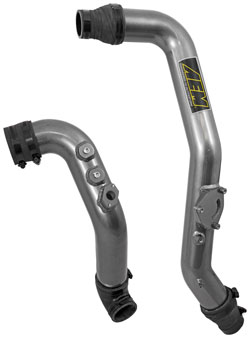
The AEM 26-3002C is a not only a mandrel-bent aluminum charge pipe kit but also offers a range of customization options.

The AEM 26-3002C is a not only a mandrel-bent aluminum charge pipe kit but also offers a range of customization options.

The sleek new 2016 Hyundai Tucson crossover looks nothing like its predecessors. In fact, it looks more like some of the new crossovers coming out of Europe and Japan. In fact, it may look even better than a few of them. Where owners are feeling a little let down is the optional 1.6-liter turbocharged four-cylinder that produces 175 horsepower – less than most of the vehicles in its class.

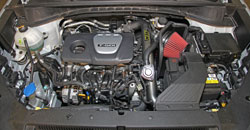
The combination of the 26-3002C and the 21-783C look great under the hood together.

The combination of the 26-3002C and the 21-783C look great under the hood together.

Because the Tucson is turbocharged and has a sophisticated engine design with twin cams, four valves per cylinder, direct fuel injection, and a sophisticated on-board computer, it can take the extra boost coming in and turn it directly into horsepower. Therefore, many enthusiasts are modifying the intake system in order to add additional horsepower. However, one set of components that shouldn’t be overlooked are the charge pipes.

AEM 26-3002C charge pipes have been engineered to deliver a more consistent, higher volume of airflow through the intercooler, especially if modifications have been made upstream, downstream, or both. AEM charge pipes reduce turbocharged air pressure loss as well as increase air flow from the turbo through the intercooler. This helps to fatten and flatten the torque curve, providing more even and consistent power delivery.

The AEM charge pipes have been designed by AEM airflow experts, making certain every bend in the pipes provides excellent flow. Not only is the AEM 26-3002C a freer-flowing charge pipe kit but also offers a wide range of performance customization options. The hot-side charge pipe features a precision machined fitting that allows for a direct bolt-on fitment of the factory blow-off valve. The cold-side charge pipe has two 1/8 inch NPT ports, should you care to add either a water-methanol injection system or a nitrous oxide injection along with a fitting to attach a temperature/boost sensor probe to monitor these modifications.

Both charge pipes are constructed from lightweight aluminum, feature smooth mandrel bends, and are finished in a durable gunmetal gray powder coated finish. Couplers are manufactured from high quality materials to withstand the temperature and pressures put through them.

A perfect partner to the AEM 26-3002C charge pipes is the AEM 21-783C performance cold air intake system, which replaces your Hyundai Tucson’s restrictive factory air filter and air intake housing. This air intake system was designed, tuned, and dyno-tested to fit the 2016 1.6T Hyundai Tucson models. The air intake tube is constructed from mandrel-bent aluminum featuring a durable gunmetal gray powder coated finish, matching the AEM charge pipes.

The oversized AEM Dryflow synthetic washable air filter is located in the original air box space and is protected by a heat shield designed to lower intake air temperature and by doing so, increase horsepower. The tapered cylinder shaped AEM Dryflow air filter is made from an oil-free, non-woven synthetic filter media that can go up to 100,000 miles between cleaning, depending on driving conditions.

With the AEM 21-783C performance cold air intake system installed, output of the 2016 Hyundai Tucson 1.6-liter turbo jumps by an estimated 14.0 horsepower, as verified on AEM’s chassis dynamometer.

Applications

2016 HYUNDAI TUCSON 1.6L L4

Plenty of Upsets and Surprises at Halfway Point in Redline Time Attack Season

David Martinez’s Indotech Miata

David Martinez’s Indotech Miata under a dramatic high desert sky

Originating on the race tracks of Japan, Time Attack is a motorsport where drivers compete against the clock, and except under special circumstances, they are not in competition fender-to-fender with other cars. To win, the driver must negotiate the racing circuit in the lowest possible time.

One of the top organizations for this sport in the US is Redline Time Attack, which hosts eight events across Southern and Central California. A Redline Time Attack weekend consists of two day events in which drivers progress throughout the day in four scheduled Time Attack sessions. Presented at the end of the weekend are both class awards as well as the prestigious award to the driver with fastest lap time for the entire event (regardless of class).

At the end of the weekend the five fastest vehicles in each class are invited to compete in a one-lap Super Session sprint race for extra championship points and an additional opportunity to lower their best time of the weekend.

Cars are broken into classes, based upon the level of modification. From mild to wild are Enthusiast Class, where modifications are severely limited and the car must be street-legal and driven to the event site, Street Class, which allows a great many more modifications, but must compete on tires with the UTQG Treadwear Rating of at least 160, the Modified Class, which are similar in construction to a Touring car, but more powerful, and can compete on DOT-R tire types, and the (almost) anything goes Unlimited Class, whose list of allowable modifications would make your head spin.

Damyan Tuchenishki in his Subaru STI

Enthusiasts’ Class point leader Damyan Tuchenishki in his Subaru STI

In each class, with the exception of Unlimited, there are sub-classes for FWD, RWD, and AWD. But there’s even a clause in the rules that allow cars to be converted from one configuration to another. For example, in Modified an AWD Subaru can be converted to RWD, but then must run in the RWD category.

So we’re here at the midpoint of the season. Four events are in the record books and four are still to come.

In the Enthusiast Class Damyan Tuchenishki has a perfect record of four events and four wins, earning 120 out of a possible 120 points available. Not only does Damyan lead the AWD division of the Enthusiast Class in his Subaru STI but he has the highest score of all competitors in the category. His closest competitor is Ryan Tanag with his BMW M3 in the RWD category, just ten points behind Damyan going into the most recent event at Buttonwillow. Ryan finished third, but missed first by only by an incredible 0.040 seconds. We’ll have to see how the Enthusiast Class battle shapes up in the second half of the season between these competitors.

Mark Jager at Buttonwillow

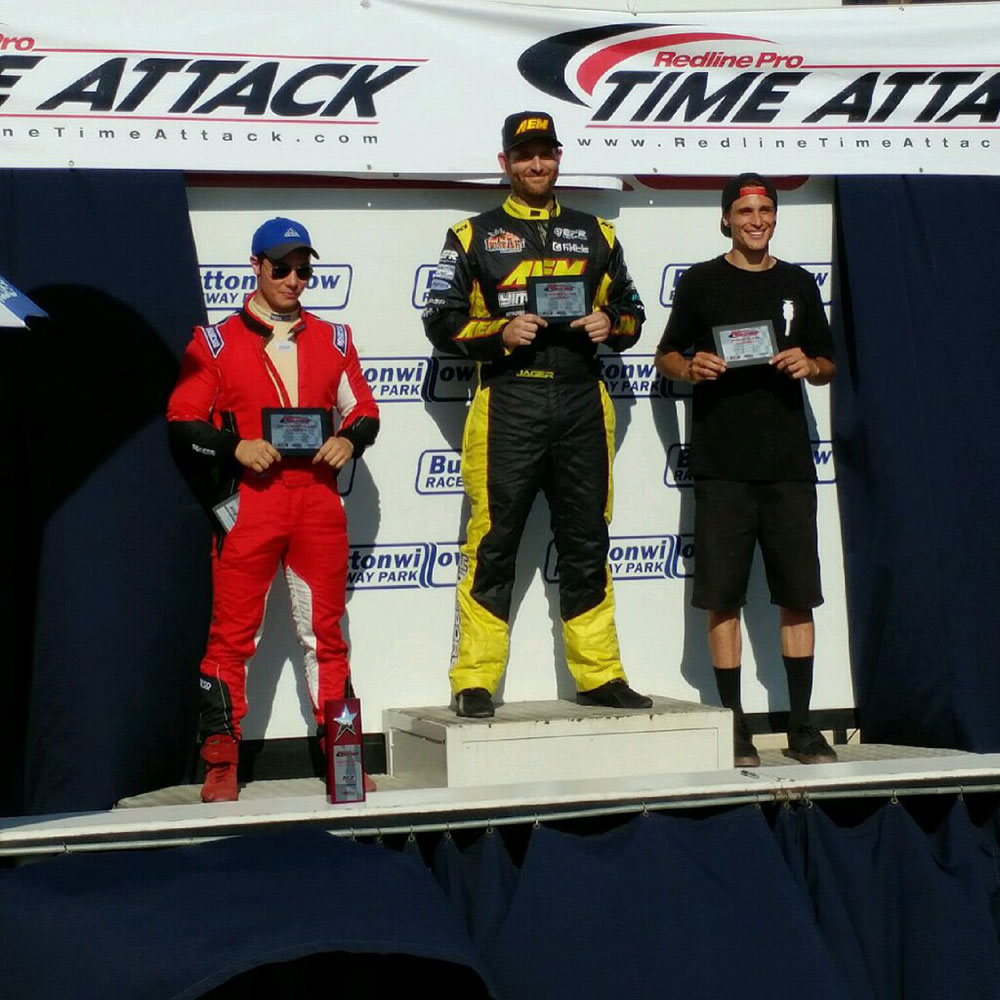
Overall and Modified Class Mark Jager winner at the most recent event at Buttonwillow

Turning to the Street Class, it’s the STIs and the EVOs that you’d be expecting at the top of the score sheet. Instead it’s Jack Thomas in his Fiat 500 Abarth in the FWD category. After three wins in a row at the opening of the season, Thomas finished third to his two rivals at Buttonwillow, Duane Bada and Ryan Canstantino at the fourth event. However the Abarth driver still maintains his points lead across all of the Street Class. The remainder of the season will determine if the Abarth is indeed the little car that could.

AEM-backed driver Mark Jager took a stunning win at Buttonwillow, grabbing the Modified points lead. Not only did he set the fastest time of the day in the Modified Class, he set the overall fastest time of the day period.

Finally, the Modified Class is being led by David Martinez, a former Marine, driving a heavily-modified (Just how modified? It has an S2000 engine under the hood) Mazda Miata prepared by Indotech Motorsports.

In the first half of the 2016 season, we’ve seen some results that might have been expected as well as some results that came as a complete surprise. We’re expecting even more and better for the second half of the season. Stay tuned!

What Do You Call a 670 RWHP 2006 Subaru STi Generating Thousands in Downforce: A Winner

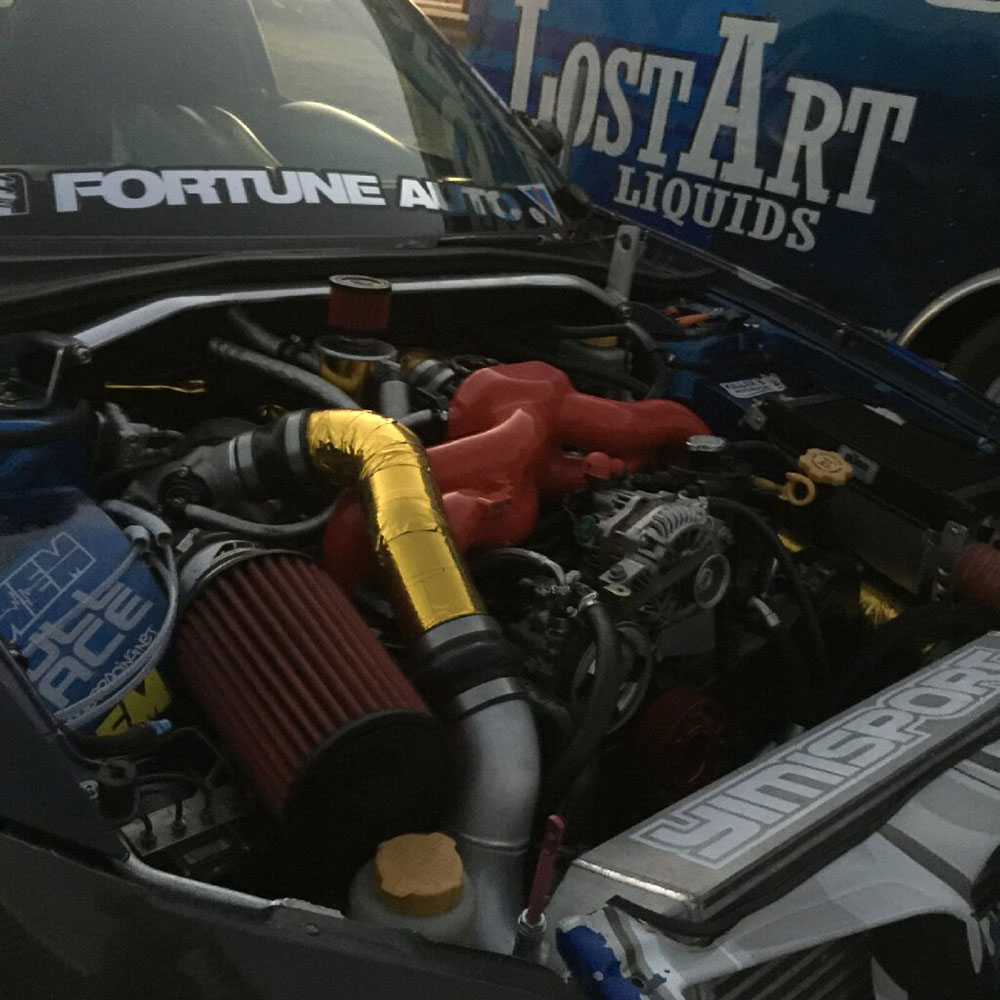
As the morning sun rises across the High Desert, the AEM filter is ready for action

As the morning sun rises across the High Desert, the AEM filter is ready for action

In the trunk of their car, the AEM crew carried with them to Willow Springs, California, brand new hats designed specifically to be given only to AEM-sponsored race winners. Little did they know they’d be passing out their first hat at that weekend’s Redline Time Attack event.

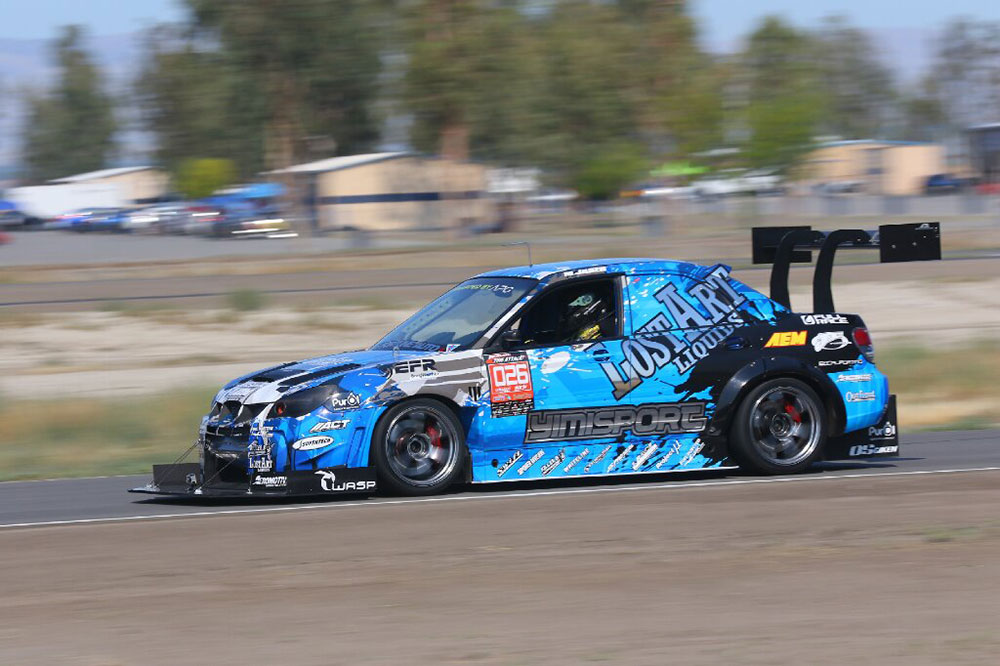
The massive front splitter and rear wing can be clearly seen this is side shot

The massive front splitter and rear wing can be clearly seen this is side shot

After a dominating performance in his Modified Class 2006 Subaru STi at the time attack run earlier this year on the full Willow Springs “big track”, Mark Jager returned to the high desert circuit to run the event on the smaller, tighter “Streets of Willow” circuit.

What makes this all so significant to AEM is that it’s the first event that Mark ran a new AEM filter configuration and took both Overall and Modified Class honors at round three of the Redline Time Attack Series. Not only that, but Mark was also carrying the new AEM logo on his car and wearing his new AEM drivers suit at the event for the first time.

If you’re not familiar with Time Attack, fear not. Here are the basics in one easy-to-swallow paragraph: Time Attack features drivers competing for the fastest single lap around a paved road racing course. The cars range from slightly upgraded to heavily modified production sedans and sports cars. Cars are classified on two criteria: its drive wheels (FWD, RWD, or AWD) and the level of modification to the vehicle. As the sport of Time Attack originated in Japan, it is often associated with Japanese cars, however vehicles of any origin can compete.

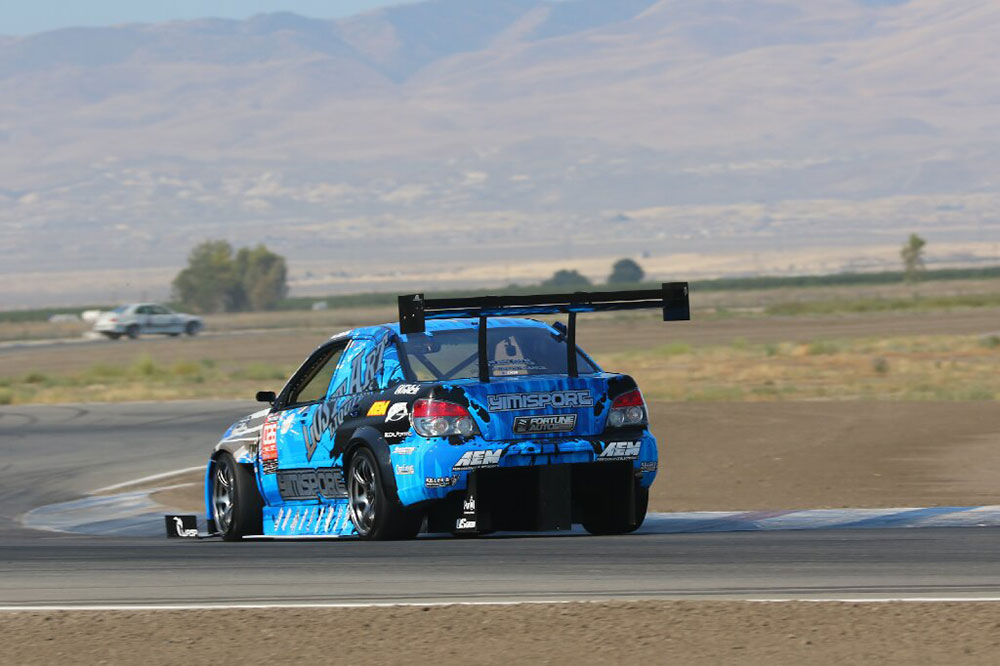
Massive rear tunnels provide a great deal of downforce as well

Massive rear tunnels provide a great deal of downforce as well

Mark proudly displays his new AEM driver suit and winner’s circle hat as he accepts the awards for both his class win as well as his overall victory.

Mark proudly displays his new AEM driver suit and winner’s circle hat as he accepts the awards for both his class win as well as his overall victory.

A bit about Mark ’s car for the 2016 season: To better balance downforce, the team added an enormous custom front splitter developed internally to counteract the downforce generated by APR Performance GT1000 dual element Swan neck wing.

Chassis set-up was a cooperation between Koherent Chassis Workz, which partnered with Yimi Sport to provide the ability to align and corner balance the car to Mark ’s liking. Taking the nearly completed car to the dyno yielded a disappointing 550 horsepower, due to largely to some debris in the fuel system. All elements were replaced and upgraded and the engine finally generated 670 rear wheel horsepower. A larger ACT clutch grabs onto all that extra power.

Engine work started with Killer B Motorsports and their sleeved EJ motor, opting to have it O-ringed to ensure that the JE Pro Seal gaskets made the best seal possible, given the internal pressures the engine will see. Flat Performance and Renner Race Development built the long block utilizing JE Pistons, GSC Billet Cams and a good deal of “magic dust”.

Some of the other good folks who support Mark in his efforts are Borg Warner, AEM Electronics, Fortune Auto, Wasp Composites, ACT and a list that goes on and on.

And to back up Mark ’s experience with AEM filters on the track, he installed an AEM Cold Air Intake System on his diesel Ram tow rig gaining approximately 11 horsepower. Further, Mark commented that more air means more usable power and acceleration throughout the engine’s RPM range. Not to mention it is CARB legal.

Lexus IS 250, IS 350 and RC 350 Cold Air Intake from AEM Adds Verified Horsepower

AEM cold air intake system for Lexus IS 250, IS 350 and RC 350

An AEM cold air intake system can add power to your Lexus IS 250, IS 350 and RC 350.

Both the 2.5L and 3.5L versions of the V6 motors fitted to the 2015 Lexus IS 250, IS350, and RC 350 are part of the Toyota GR family of engines. They all feature an open-deck, 60° die-cast aluminum block with aluminum DOHC, four valves per cylinder heads. This engine also features forged steel connecting rods, one-piece cast camshafts, and a cast aluminum lower intake manifold. The 2.5 L version of Toyota's GR motor retains the same bore as the 3.5 L engine, but with a shorter stroke to achieve the smaller displacement.

AEM cold air intake system installed in the Lexus IS 250, IS 350 and RC 350

Under hood installation is a straightforward process that takes around 90 minutes.

With the deep breathing capabilities of the dual-overhead camshaft four-valve per cylinder head, what often limits power is the factory air intake system. Compromised for any number of reasons, the stock system doesn't deliver the airflow to the engine that an AEM 22-688C cold air intake can.

The AEM cold air intake is a relatively inexpensive DIY modification that takes around an hour and a half to install with tools just about everyone has in their garage.

The results of AEM testing are that an otherwise stock 2.5L V6 Lexus IS-250 on the chassis dynamometer, the AEM 22-688C bolted to the test vehicle output power increased to 169 horsepower and 152 ft-lbs. of torque.

The AEM 22-688C air intake system ingeniously capitalizes on the large OEM intake filter housing so only lower-temperature outside air can reach the AEM replacement air filter provided. Cooler air is denser, carrying additional oxygen to which your engine adds more fuel, the requirement in increasing horsepower.

The filter itself is an OEM-sized (drop-in) non-woven synthetic filter media to help protect your engine from harmful road grit.

The air intake system comes complete with an AEM low restriction air filter, gunmetal grey powder-coated intake tubing. The AEM 22-688C air intake systems come with the necessary boots, clamps, and hardware for an OEM-type appearance. The kit also accommodates all factory emissions and vacuum lines. OEM mounting brackets and hardware are utilized for seamless installation.

Your AEM air filter is good for about 100,000 miles with proper service (depending upon your driving conditions). Cleaning consists of an application of AEM synthetic air filter cleaner which will loosen and dissolve grime and dirt built up on the filter, after which the filter can simply be rinsed with water, allowed to air dry and reinstalled. No oiling required.

The 22-688C fits the following vehicles:
2015 Lexus RC350 3.5L V6
2015 Lexus IS350 3.5L V6
2015 Lexus IS250 2.5L V6

You can view all the air intakes that AEM makes for these vehicles at the Air Intake Systems for the Lexus RC350, Air Intake Systems for the Lexus IS350, and Air Intake Systems for the Lexus IS250 pages. You can view all the air filters that AEM makes for these vehicles at the Air Filters for the Lexus RC350, Air Filters for the Lexus IS350, and Air Filters for the Lexus IS250 pages. You can view all the AEM performance products for any vehicle by using the Search by Vehicle tool and you can find a local AEM retailer by plugging your location into the AEM Dealer Search as well.