Latest News

AEM Filter Designed to Improve Power and Response in 2010-2017 Equinox & Terrain

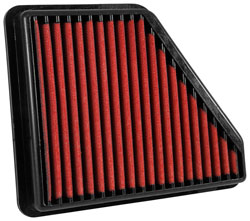
AEM Dryflow Replacement Filters are designed to increase power without causing addtional engine wear

An AEM Dryflow replacement filter helps your Equinox or Terrain breathe better

General Motors produces a full line of crossovers and SUVs across its Buick, Cadillac, Chevrolet, and GMC brands. As can be expected, there are certain components that are shared across brands offering similar-sized vehicles.

This is the case with GM’s compact Sport Utility Vehicles, the Chevrolet Equinox and the GMC Terrain. From 2010 through 2017, despite the fact that several different engines have been available, if you own one equipped with a 2.4L, 3.0L, or 3.6L engine, they all utilize the same air filter. And fortunate for the owners of those vehicles, AEM manufactures the 28-20439 replacement filter for their vehicles that will both improve power and response as well as reduce the number of filters you need to purchase over the life of the vehicle.

The applications are:

2010 - 2017 Chevrolet Equinox and GMC Terrain equipped with a 182 horsepower GM Ecotec LEA 2.4L four cylinder engine. The engine features a DOHC aluminum cylinder head with continuously variable valve timing, aluminum pistons with jet-spray cooling, and direct fuel injection driven by a high-pressure mechanical pump.

A single AEM Air Filter can replace a pile of discarded filters headed for the landfill

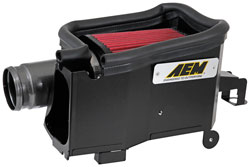
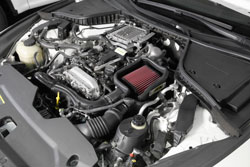
The air filter is easy to access, located inside the air box on the left side of the photograph

2010 - 2012 Chevrolet Equinox and GMC Terrain equipped with a 264 horsepower GM High Feature LF1 3.0L V6 engine. Both block and cylinder heads cast from aluminum. It features dual overhead camshafts with four valves per cylinder operated by variable valve timing, and direct fuel injection (also applies to those models fitted with the LFW flex-fuel version).

2013 - 2017 Chevrolet Equinox and GMC Terrain equipped with a 301 horsepower GM High Feature LFX 3.6 L V6 engine. The engine offers the same features as the LF1 with a new cylinder head design, larger intake valves, revised camshafts, new fuel pump and injectors, stronger and lighter weight connecting rods and across-the-board E85 capabilities.

AEM replacement air filters combine some of the best elements of cotton air filters into a next-generation Dryflow air filter. This new three-dimensional filtering medium is red in color.

The AEM 28-20439 uses both depth loading and structural screen wire to enhance airflow capabilities for better engine performance. The incremental airflow is designed to add power as the engine management system recognizes the increase in available air and adds incremental fuel, the result being a potential increase in power.

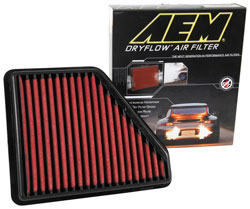
Complete detailed and illustrated installation instructions are included in the box

Everything needed to improve the airflow of your Equinox or Terrain is included in the box

AEM Dryflow air filters are washable synthetic air filters designed to optimize air flow and performance without sacrificing filtration. AEM Dryflow filters use an innovative high-performance oil-free filtration material that allows easy cleaning, durable service, and excellent filtration.

The only maintenance required for your AEM 28-20439 replacement filter is a service easily completed on your own. At intervals of 50,000 miles (depending on your driving conditions) utilize a AEM air filter cleaning kit to clean and re-oil your air filter -- bringing it back to like-new condition and ready for another 50,000 miles of driving. Your one AEM air filter is designed to last for the lifetime of your vehicle, which AEM guarantees will last for the life of your vehicle.

The AEM 28-20439 is designed to fit the following vehicles:

2017 GMC TERRAIN 3.6L V6 Fuel Injection - All Models
2017 GMC TERRAIN 2.4L L4 Fuel Injection - All Models
2017 CHEVROLET EQUINOX 3.6L V6 Fuel Injection - All Models
2017 CHEVROLET EQUINOX 2.4L L4 Fuel Injection - All Models
2016 GMC TERRAIN 3.6L V6 Fuel Injection - All Models
2016 GMC TERRAIN 2.4L L4 Fuel Injection - All Models
2016 CHEVROLET EQUINOX 3.6L V6 Fuel Injection - All Models
2016 CHEVROLET EQUINOX 2.4L L4 Fuel Injection - All Models
2015 GMC TERRAIN 3.6L V6 Fuel Injection - All Models
2015 GMC TERRAIN 2.4L L4 Fuel Injection - All Models
2015 CHEVROLET EQUINOX 3.6L V6 Fuel Injection - All Models
2015 CHEVROLET EQUINOX 2.4L L4 Fuel Injection - All Models
2014 GMC TERRAIN 3.6L V6 Fuel Injection - All Models
2014 GMC TERRAIN 2.4L L4 Fuel Injection - All Models
2014 CHEVROLET EQUINOX 3.6L V6 Fuel Injection - All Models
2014 CHEVROLET EQUINOX 2.4L L4 Fuel Injection - All Models
2013 GMC TERRAIN 3.6L V6 Fuel Injection - All Models
2013 GMC TERRAIN 2.4L L4 Fuel Injection - All Models
2013 CHEVROLET EQUINOX 3.6L V6 Fuel Injection - All Models
2013 CHEVROLET EQUINOX 2.4L L4 Fuel Injection - All Models
2012 GMC TERRAIN 3.0L V6 Fuel Injection - All Models
2012 GMC TERRAIN 2.4L L4 Fuel Injection - All Models
2012 CHEVROLET EQUINOX 3.0L V6 Fuel Injection - All Models
2012 CHEVROLET EQUINOX 2.4L L4 Fuel Injection - All Models
2011 GMC TERRAIN 3.0L V6 Fuel Injection - All Models
2011 GMC TERRAIN 2.4L L4 Fuel Injection - All Models
2011 CHEVROLET EQUINOX 3.0L V6 Fuel Injection - All Models
2011 CHEVROLET EQUINOX 2.4L L4 Fuel Injection - All Models
2010 GMC TERRAIN 3.0L V6 Fuel Injection - All Models
2010 GMC TERRAIN 2.4L L4 Fuel Injection - All Models
2010 CHEVROLET EQUINOX 3.0L V6 Fuel Injection - All Models
2010 CHEVROLET EQUINOX 2.4L L4 Fuel Injection - All Models

clear

AEM PRODUCT SEARCH     WHERE TO BUY AEM

AEM Cold Air Intake Adds an Estimated 11 Horsepower To 2016 Infinti Q50 Sedan

AEM Cold Air Intake Systems are designed to add horsepower and torque

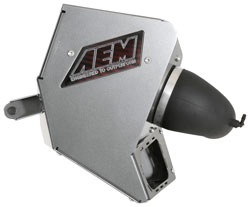
The AEM cold air intake kit is comprised of the aluminum intake tube, heat shield and Dryflow filter

The 2016 Infiniti Q50 is powered by a new engine that produces 208 SAE net horsepower at 5500 rpm. And with a simple, inexpensive and easy to install AEM 21-807C cold air intake, you can increase power at the drive wheels by 11 horsepower. Keep in mind the AEM 21-807C kit would measure even higher under the SAE Net test, as it’s measured at the flywheel and doesn’t account for power consumed by the drivetrain.

The 2.0L inline turbocharged four-cylinder engine features a die-cast aluminum block complemented by an aluminum DOHC cylinder head. The engine features direct fuel injection and multiple-spark ignition. Compressed intake air passes through an air-to-air intercooler that lowers the charge air temperature before it enters the combustion chamber. On the exit side of the turbo, a vacuum-controlled wastegate improves efficiency. The engine is backed by a seven-speed automatic transmission.

AEM DryFlow air filters feature a non-woven synthetic media and no oiling is required

AEM Dryflow filters provide excellent filtration, long service, and easy cleaning without filter oil

With the AEM 21-807C air intake system installed, intake air enters the system through the oversized oval tapered 21-2128DK AEM air filter, which is mounted in the original factory air box location, replacing the OEM part. The box is sealed from engine heat so that it doesn’t further raise the temperature of the intake flow.

The AEM Dryflow filter utilizes a washable, non-woven synthetic filter medium optimized for high air flow, excellent filtration, and improved performance. In fact, a Dryflow filter captures up to 99% of harmful contaminants before they reach your engine.

Intake air exits the filter and travels through a free-flowing aluminum intake tube that easily connects to your vehicle’s factory intake to significantly increase air flow into your Infiniti engine. With more air flowing through the application-tuned gun metal gray intake tube, the engine develops more horsepower and more torque.

The AEM 21-807C cold air intake is a relatively straightforward DIY modification that takes just a few hours to install, even for someone with little mechanical experience. Tools required are those that just about everyone has in their garage. The AEM 21-807C utilizes only the factory mounting locations, so there are no holes to drill or permanent modifications to make.

Installation of the AEM Cold Air Intake System should take less than a Saturday morning

The 21-807C cold air kit replaces the factory air box with no modifications to the car required

Your AEM 21-2128DK air filter is good for about 100,000 miles with proper service (depending upon your driving conditions). If you drive regularly in dusty or dirty conditions, your filter will probably require more frequent inspection and maintenance. Cleaning is straightforward and consists of an application of AEM 1-1000 synthetic air filter cleaner. The AEM cleaner loosens and dissolves dirt and grime collected by the filter, after which the filter need only be rinsed with water, dried, and reinstalled.

You can purchase the AEM 21-807C cold air intake factory direct for your 2016 Infiniti Q50 here on the AEM site, as well as the AEM replacement filter 21-2128DK and the AEM 1-1000 synthetic air filter cleaner.

The AEM 21-807C is designed to fit the following vehicles:

2016 INFINITI Q50 2.0L L4 Fuel Injection - All Models

clear

AEM PRODUCT SEARCH     WHERE TO BUY AEM

Distinctive AEM Cold Air Intake Kit Adds Horsepower to 2017 Audi A4

AEM Dryflow Filters increase power while protecting the engine from contaminants

The AEM 21-815C intake for Audi A4 provides a larger air box to fit an oversized Dryflow filter

The fully redesigned 2017 Audi A4 features an engine described by the editors of Car and Driver as “TFSI engine proved impressively torquey and willing to rev to its power peak, and while turbo lag is minimal, midrange throttle response is fabulous.” AEM can further supplement the performance of the 2017 Audi A4 with its 21-815C cold air intake kit, which adds another 11 horsepower to the 252 with which it left the Audi factory.

The turbocharged four-cylinder engine is comprised of a cast-iron block and aluminum cylinder head. The valvetrain is of a double overhead camshaft (DOHC) configuration, with four valves per cylinder controlled by the Audi valvelift system. A bore of 82.5 mm and a stroke of 92.8 mm provides a displacement of 1984 cc, rounded up to 2.0 L. The 2017 A4 engine produces 252 horsepower and 273 lb-ft of torque.

The 21-815C has been developed by AEM engineers to take advantage of Audi’s use of forced induction. As the Audi A4 is turbocharged, it has a greater capacity for increased horsepower over normally-aspirated engines. By packing the turbocharger to capacity with cool, fresh intake air the engine’s Electronic Control Unit (ECU) will respond by adding more fuel. The equation is simple: more air plus more fuel equal more power.

If you’re familiar with turbocharged engines you recognize that the act of compressing the intake air heats it up considerably, as a function of how much the turbocharger pressurizes the incoming air. Internal combustion engines work best with cool intake air, so an intercooler is typically installed between the turbocharger and the intake ports. A cold air intake system actually assists your engine’s intercooler, as it delivers cooler air to the turbocharger, the output of which is lower in temperature, supplementing the drop in intake temperature the intercooler is designed to deliver.

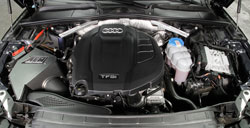
The large AEM air box accomodates an oversized Dryflow air filter for increased power

The AEM air box is assembled outside the car for simple and easy installation using OEM hardware

The 21-815C intake system is a new design concept which allows for the full-assembled AEM replacement air box to simply be dropped in place of the OEM Audi unit. The air box is assembled outside the car and is then positioned in the engine compartment, utilizing only OEM mounting hardware. The AEM aluminum air box keeps hot engine air from entering the air intake system and directs cooler air to the filter using the factory inlet scoop.

The filter itself is an oversized AEM 21-209DK Dryflow filter with a 7.5” base diameter. The Dryflow filter is constructed of an innovative high-performance synthetic filter material. The washable, non-woven oil-free synthetic filter medium has been specified for its ability to deliver high air flow, excellent filtration, and improved performance. In fact, a Dryflow filter captures up to 99% of harmful contaminants before they can reach your engine.

While AEM Dryflow air filters typically do not require service until after about 100,000 miles of normal driving, a window is provided through which you can inspect the filter at any time. There’s also an AEM logo burnished on the window, so when your raise the hood on your A4 at the next Saturday morning “Morning Beverage and Motors” get-together everyone present will recognize you’re serious about performance.

Despite the fact that the air box needs to be assembled outside the car, the construction and installation of the AEM 21-815C cold air intake is a relatively straightforward DIY modification. The entire process should take just a few hours to install with just a few common hand tools you probably already own. The AEM 21-815C utilizes only the factory mounting locations, so there are no holes to drill or permanent modifications to make.

In most driving situations, a Dryflow filter doesn't require cleaning for up to 100,000 miles

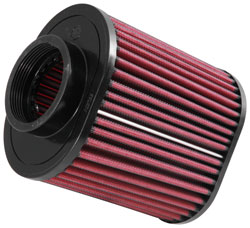
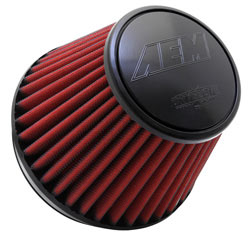
The tapered cylinder shaped AEM Dryflow air filter is made from an oil-free, synthetic filter media

Cleaning the Dryflow filter consists of an application of AEM 1-1000 synthetic air filter cleaner. The cleaner loosens and dissolves dirt and grime collected by the filter, after which the filter need only be rinsed with water, dried, and reinstalled. If you drive regularly in dusty or dirty conditions, your filter will probably require more frequent inspection and maintenance.

The AEM 21-815C is designed to fit the following vehicles:

2017 AUDI A4 QUATTRO 2.0L L4 Fuel Injection - All Models
2017 AUDI A4 2.0L L4 Fuel Injection - All Models

clear

AEM PRODUCT SEARCH     WHERE TO BUY AEM

Mark Jager Prepares his 2006 Subaru WRX STI for Unlimited Class Time Attack

Photo courtesy Mark Jager Racing

Mark Jager set class records at multiple Redline Time Attack events in 2016 in his Subaru WRX STI

Time attack racing in the United States gives drivers an opportunity to chase record-setting laptimes with heavily modified cars that often don’t fit the rule structures of traditional racing. Mark Jager originally purchased a 2006 Subaru WRX STI fresh off a dealership lot back in 2006. While the car was initially modified with an AEM 21-477C intake and a bolt-on exhaust, the car would eventually get turned into a full race car over the period of around 5 years. Jager’s addiction to chasing lap times started when his wife innocently purchased a track day experience as a gift in 2012. A few months later, Jager entered his first Time Attack competition. The addiction had begun, and Mark Jager’s Subaru WRX STI would never be the same.

Photo courtesy Mark Jager Racing

Mark Jager sets up his pit at Super Lap Battle at Buttonwillow Raceway

Jager began entering Extreme Speed track events, and soon found himself volunteering for the organization. Jager snagged time with several instructors to learn some tips and tricks to push the Subaru WRX STI to its’ limits, and soon found himself instructing new drivers himself. At the end of the season, Jager entered the annual Super Lap Battle competition at Buttonwillow and finished in 5th position in the Street AWD class. A junkie had been introduced to his new habit.

Over the next three seasons, Jager would move up the chain of proverbial Time Attack command. Jager became the AWD Street class champion in both Redline Time Attack and the Extreme Speed series in 2013, setting several track records along the way. Jager would continue smashing records in 2014, and continue his success in the Street class before moving up to the Limited/Modified class in 2015. Unfortunately, the growth wasn’t completely seamless as the 2015 season was marked with blown motors, poor advice, and a ton of hurdles for the team. But by the end of the 2015 season, Jager had a setup that was ready to dominate the Limited/Modified classes in various Time Attack organizations for the following year.

Photo courtesy Mark Jager Racing

Mark Jager took the Unlimited AWD and Overall win at Super Lap Battle in November 2016

As rules would have it, Jager would get pushed out of Modified AWD and into the Unlimited class by the end of 2016. Taking the challenge head-on, Jager and the team prepped for the “Super Bowl of Time Attack” known as Super Lap Battle in the Unlimited AWD class, and took the overall class and event win despite facing several issues throughout the competition. Looking ahead to the 2017 season, Jager and the team had some key decisions to make. Some rule changes in 2016 had pushed the team from the Limited / Modified class into the Unlimited class, and Jager was at a crossroads. There was an opportunity to make some sacrifices to the car and reduce the aero package and tire package that they were used to running to stay in the lower class, or they could continue to push the limits of speed and pursue the Unlimited class with full commitment.

The debate didn’t last long, as Jager is a speed demon at heart. The decision was made to go the Unlimited route, and make every upgrade possible to maintain the top step of the podium.

Photo courtesy Mark Jager Racing

Mark Jager set Modified Class Records at WSIR (1:23.129) and Streets of Willow (1:18.144) in 2016

As the team started planning for the upgrades that would take place in the off-season prior to the 2017 racing schedule, data became a key factor moving forward. “The best teams can unload their car from the trailer and put down fast laps in a short amount of time because they have substantial amounts of data based on what has worked in previous seasons”, said Jager. Data Acquisition suddenly became the biggest priority for the team, and a full overhaul was planned out that included a new standalone ECU, data logger system, and digital dash display. Since the new standalone ECU would require a full rewire, and the Unlimited class allows the team to completely remove the dashboard, a full overhaul was carefully planned and executed shortly after Super Lap Battle in 2016. Subaru wiring specialists iWire stepped up to take care of the entire wiring process for Jager, which gave piece of mind to the team.

The car was rewired and ready just in time to be debuted in the AEM booth at Formula Drift Long Beach in April. Time Attack fans may seem rare at a drifting event, but the appreciation for data logging and speed is shared among all motorsports fans and the car was very well received. Shortly after the event, more upgrades were made in preparation for the 2017 season. Weight reduction became a major focus as a carbon fiber roof was installed, and a Lexan windshield replaced the OEM glass at the front of the car. Tubular subframes are a no-no in the modified class, but with the aforementioned move into the Unlimited class, a tubular rear subframe became another opportunity to save weight and improve the suspension geometry simultaneously.

Photo courtesy Mark Jager Racing

Mark Jager ran a career-best time of 1:41.309 at Buttonwillow Raceway in November 2016

Initial plans for the 2017 season were to debut the car at the Motovicity Speedring event and defend Jager’s 2016 Unlimited AWD class win, but a change in venue from Autoclub Speedway in California to the M1 Concourse venue in Michigan will keep the team from debuting in September. All sights are now set to continue revising and improving the chassis in time for the Super Lap Battle event at Buttonwillow in November. Jager has found a lot of success over the years at Super Lap Battle, and hopes to continue that success with the newly revised chassis while starting the lengthy data gathering process that will only improve future succes.

Career Accomplishments:

2016 Redline Time Attack AWD Modified Class Records at WSIR (1:23.129) and Streets of Willow (1:18.144)

2016 Motovicity Speedring First place AWD Class / 3rd place Overall at Autoclub Speedway (1:38.307)

2016 Super Lap Battle 1st place Unlimited AWD / Overall event winner at Buttonwillow Raceway (1:41.309)

2015 3rd Place Limited AWD Class - Global Time Attack Super Lap Battle at Buttonwillow Raceway (1:46.906)

2014 Redline Time Attack & Global Time Attack Street Class Champion

2014 Overall and Street Class AWD records at Buttonwillow (1:50.207), Big Willow (1:25.487), Autoclub Speedway Infield (1:10.105), and Chuckwalla CW (1:55.316)

2013 Redline Time Attack Street Class Champion

2013 Extreme Speed AWD Competition Street Class Champion

2013 Street Class Time Attack Records at WSIR (1:27.367), Autoclub Speedway Roval (1:45.394), and Chuckwalla CW (1:59.716)

2013 Eight 1st Place finishes at Redline Time Attack

2013 2nd Place Street AWD class – Super Lap Battle Buttonwillow CW

2012 5th place Street AWD Class - Super Lap Battle

clear

AEM PRODUCT SEARCH     WHERE TO BUY AEM

How 2004 Mitsubishi EVO 8 Driver Roy Narvaez Finally Conquered Pikes Peak

Roy Narvaez conquers the 2017 Pikes Peak Hill Climb in his Mitsubishi EVO

Roy Narvaez conquers the 2017 Pikes Peak Hill Climb in his Mitsubishi EVO

America has been described as a land of ‘opportunity’, and a young man named Roy Narvaez decided to seize that opportunity to make a better life for himself. As a teenager, Roy learned everything he could about computers, then parlayed that knowledge into a successful IT career. By 1999 he could finally afford to indulge his fascination with cars, so he bought a 1995 Mitsubishi Eclipse GSX. This little pocket rocket was equipped with the turbocharged Mitsubishi 4G63 2.0L, which sent 210-hp to all four wheels through a permanent AWD system. Roy said, “I was 20 something years old, and I thought that was the coolest, fastest thing that ever existed.”

He soon discovered LA’s underground street racing scene and decided to try his hand at drag racing. It didn't take long for Roy to want even more power, and he eventually tuned the Eclipse all the way up to 700 hp. “This was before Fast & Furious came out, so there were only like 20 cars, and it was the same 20 cars every week. We used to race from like 10 o'clock at night, till 2 or 3 in the morning. And if a cop came by, they usually just asked if we were OK, then sometimes they would tell us stories about when they were young and used to race. Then that movie came out, and it kind of ruined the whole scene. It went from 20 guys having fun, to literally a couple of hundred. It was insane. There were people everywhere, people acting a fool, people crashing. So I got out of that scene and went to the Pomona Drag Strip to compete in the NHRA import circuit.”
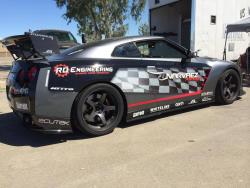
R35 Nissan GTR modified by Narvaez Racing

R35 Nissan GTR modified by Narvaez Racing

After a few years, Roy said he “made the grown-up decision” to sell his Eclipse, get out of the car scene and focus on his career. Then one day in 2009, he was driving home from work and passed what appeared to be a Nissan GT-R. Since he had been out of the car scene for several years, he didn't know that the R35 Nissan GT-R was being legally sold in the United States. So he followed the driver and asked him how he got it into the country. Much to his surprise, the owner told Roy that he had bought it at the local Nissan dealership. A year later, Roy had his very own GTR, and naturally, he started road racing.
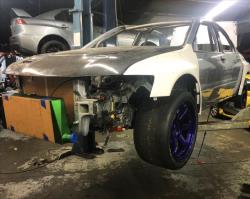
2004 Mitsubishi EVO VIII being rebuilt by Narvaez Racing for the 2015 Pikes Peak Hill Climb

2004 Mitsubishi EVO VIII being rebuilt by Narvaez Racing for the 2015 Pikes Peak Hill Climb

By this time Roy had left the IT field, and started a successful chain of laundromats. So when his longtime friend and mechanic Robert Garcia suggested they go check out the Pikes Peak race, he was able to simply jump on a plane and fly out to Colorado. Roy first learned about the Pikes Peak Hillclimb during his street racing days and loved the idea of people drifting up a mountain. “I liked off-roading, I like racing, and it was like the perfect marriage of both. I wanted to do it but just couldn't afford it back then. When we were out there, I got to drive up the mountain in our rented Fiat. But I wasn't considering it because I felt that it was a little above my driving skills.”

On the way back home, his friend Robert suggested they build a Pikes Peak car, and told him the owner of Road Race Engineering had the perfect car to use: a wrecked 2004 Mitsubishi EVO 8. Then one day the owner of RRE asked Roy if he wanted to buy the EVO. He offered to sell it to him cheap, but only if he was going to build a Pikes Peak car with it. Roy said “So I bought it, and it just sat there. I also applied to enter the race, and surprisingly I was excepted. This happened in February 2015, the race is in June, and the car wasn't even built.” So he went to the shop and gutted it to remove all of the unnecessary weight.
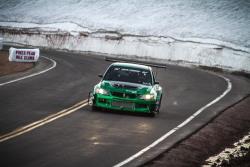
Roy Narvaez finished 12th in the Time Attack 1 class at the 2017 Pikes Peak Hill Climb

Roy Narvaez finished 12th in the Time Attack 1 class at the 2017 Pikes Peak Hill Climb

The Hulk EVO as it would become known had been rather seriously rear-ended and required a fair amount of bodywork to be drivable. Once that was complete, they installed a roll cage, a new transmission, new axles, and got it wrapped. Roy continued, “To be honest with you, the car wasn't ready when we left. It had been built in 3 months, but still needed a windshield, it needed to be tuned, and there was no aero on it. So at the end of each practice today, we would go to a local shop in Colorado and work on the car. The EVO was finally finished on race day. And I actually qualified in the middle of the pack, with no aero on the car!” Incredibly, this was the first time that Roy had ever driven the car. However, on the morning of the race, weather conditions quickly deteriorated and Roy was only able to make it halfway up the mountain.
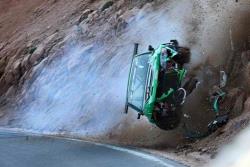
Real-time shot of Roy Narvaez crashing at the 2016 Pikes Peak Hill Climb

Real-time shot of Roy Narvaez crashing at the 2016 Pikes Peak Hill Climb

With no luck climbing the 14,115 ft mountain, the crew of Narvaez Racing returned to California to finish building their car. After lots of fine tuning, they returned to Colorado, to once again take on the 12.42 mile Race to the Clouds. Except this time, they had plenty of time to practice, and the car ran great. Roy qualified in the top 10 of his class on Thursday, so Friday would have been an optional practice day. Initially, he wanted to take Friday off, that way everybody could just relax and enjoy the experience. But Roy eventually decided to go out for a practice run anyway.

That Friday morning was rather cold, and during the first section of his practice session, Roy was unhappy with his performance. He explained, “I turned in too early, I braked too early, it was just a bad run. Then I started getting into the groove. So to make up, I started pushing it. and I was going way too fast into one of the turns. I had cold tires on a cold road, and I locked up the brakes. I knew I was going to hit, but it happened so fast, it was like I blinked and it was over. And once I landed, my first thought was “Man, this is going to be a lot of work for the crew” I felt bad for them. But it didn't dawn on me until later, that there was a big cliff on the other side!”
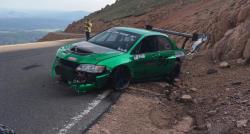
The Mitsubishi EVO driven by Roy Narvaez nearly went off the mountain at the 2016 Pikes Peak Race

The Mitsubishi EVO driven by Roy Narvaez nearly went off the mountain at the 2016 Pikes Peak Race

The damage to the little green EVO was pretty severe, and Roy was extremely lucky that his car landed where it did. Roy said that all of the drivers offered to lend a hand. “Time, tools, parts, some even offered to lend us a shop to do the work in. I've raced Time Attack, 24 hours of Lemons, drag racing, but I've never been a part of anything where people were willing to give up their time, and their parts, just to help you finish this race.” But after surveying the damage to his car, Roy decided not to continue. “I've already crashed with a great car, and I didn't want to put myself in the situation where we're running a car that might not be 100%." So Roy and his team returned home, disappointed that they were unable to finish the 2016 Pike's Peak Hill Climb for a second time.
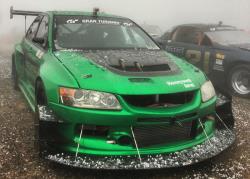
The Narvaez Racing Hulk EVO in a hail storm on Pikes Peak

The Narvaez Racing Hulk EVO in a hail storm on Pikes Peak

Over the next year, Narvaez Racing repaired the Hulk Evo with the help of their friends at Road Race Engineering. Many of the EVO’s parts got either updated or upgraded, in preparation for the 2017 Pikes Peak International Hill Climb. Roy said: “They say the third year is this charm, and this year I made it all the way to the top of the mountain!" With a time of 12:15.773, he finished in 12th place out of 24 cars in the Time Attack 1 class for modified production cars. This is a particularly tough class to compete in, considering it’s filled with professional racing drivers like Rhys Millen, who placed first in this class with a staggering time of 9:47.427. David Donohue, who won the GT2 Class at LeMans in 1998, finished second in the Time Attack 1 class with a time of 9:49.954. British Touring Car Championship driver Robb Holland and Honda R&D Engineer James Robinson (driving a factory-sponsored Acura NSX) also competed in Roy’s class. So finishing in the middle of a field packed with that much talent is quite an accomplishment.
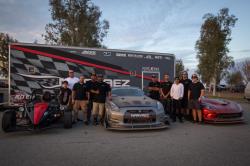
Narvaez Racing Team posing with their Ariel Atom, R35 Nissan GT-R, and Dodge Viper ACR

Narvaez Racing Team posing with their Ariel Atom, R35 Nissan GT-R, and Dodge Viper ACR

“I was pushing the car to its limits on the first and middle sections, then the fog started to roll in, which makes it difficult to figure out where you're going to brake. So I slowed down a little bit towards the top. But when I reached the top, I was just so happy that I made it. It took three years to reach this goal. It's not like any other race that I've ever competed in. When you get to the top, all of the other drivers are happy for you. The Pikes Peak Hillclimb isn't about competing against other drivers so much, as it's man and machine versus the mountain.”

As far as the 2018 Pikes Peak Hill Climb is concerned, Roy says he may return with the Hulk Evo, however, he hasn't ruled out taking something different. He does have a race-prepped Nissan GTR, a Dodge Viper ACR, and an insane little Ariel Atom that runs on ethanol. So he has a few interesting options already sitting in his garage. But no matter what car he brings, we at AEM can't wait to watch Roy Narvaez compete in the next Race to the Clouds.

clear

AEM PRODUCT SEARCH     WHERE TO BUY AEM