Latest News

Fredric Aasbo Becomes Winningest Driver in Formula Drift History in 7 Short Seasons

Fredric Aasbo celebrates his 10th career Formula Drift win in Montreal, most overall by any driver

Fredric Aasbo celebrates his 10th career Formula Drift win in Montreal, most overall by any driver

As a teenager, Fredric Aasbo watched drifting videos on DVD and YouTube, dreaming of being able to earn a living from the sport. Aasbo began sliding his Toyota Supra in Norway in the mid-2000s and rose to the top of the Nordic drifting series by winning back-to-back championships in 2007 and 2008. Near the end of the 2008 season, Aasbo was given an opportunity to bring his Toyota Supra to the United States to compete in an invite-only drifting ‘shootout’ that took place in the Port of Long Beach. At that event, Aasbo got his first taste of drifting in the United States and set a goal to be competing for full-time in the United States in the coming years.

In 2010, Aasbo pieced together a privateer program and competed in five of seven events in the Formula Drift championship. At his debut event in Long Beach, Aasbo piloted his Toyota Supra, nicknamed “Chucky”, to a 4th place overall finish. Aasbo would sit out the second and third rounds that season due to budget restrictions but would compete in the final four rounds of the season. Aasbo placed in the Top-8 at two of those four remaining events, finishing the season in 13th position overall and winning the Rookie of the Year award from Formula Drift. Between the 2010 and 2011 seasons, Formula Drift staged a pair of exhibition matches at Yas Marina Circuit in Abu Dhabi, UAE, and Qatar Racing Club in Doha, Qatar. Aasbo was on the short list of drivers selected to go to these events and would make the most of the opportunity by winning the Yas Marina exhibition and placing third at Qatar Racing Club.

Fredric Aasbo battles Tanner Foust in 2010. Aasbo would join Papadakis Racing for the 2011 season

Fredric Aasbo battles Tanner Foust in 2010. Aasbo would join Papadakis Racing for the 2011 season

Aasbo would be recognized for his performance and consistency by Papadakis Racing, who signed him to drive a newly built Scion tC2 for the 2011 season. Aasbo had big shoes to fill as Tanner Foust, the previous Papadakis Racing driver, was moving on from drifting to pursue Rallycross and television hosting but left the sport as the only back-to-back champion and winner of seven Formula Drift events. Aasbo would adapt to the new Scion tC2 and Papadakis Racing team very quickly, taking a Top 8 finish in his first event at Long Beach and a podium finish at the fifth event at Evergreen Speedway. Over the first three seasons, Aasbo would take home four podium finishes and would end the season in 12th position, 6th position, and 4th position, showing continual progress and consistency.

Fredric Aasbo drifts the Papadakis Racing Scion tC2 at Road Atlanta in 2011

Fredric Aasbo drifts the Papadakis Racing Scion tC2 at Road Atlanta in 2011

2014 would be a breakout year for Aasbo, finally landing his first event win in New Jersey. A second event win at Texas Motorspeedway, combined with two other podium finishes at Road Atlanta and Irwindale Speedway, pushed Aasbo to a second place overall finish in the championship. Aasbo actually had a chance to win the championship in the final battle of the final event at Irwindale Speedway, but a loss to Daigo Saito in that battle would hand the championship to Chris Forsberg. Getting so close to the championship motivated Aasbo and the Papadakis Racing team to attack the 2015 season hard. Several upgrades were made in the offseason to increase the horsepower and reliability of the 2AR-FE engine, which was the most powerful 4-cylinder engine in the series.

Fredric Aasbo piloted a Scion tC2 from 2011 to 2016 before stepping into a Toyota Corolla iM in 2017

Fredric Aasbo piloted a Scion tC2 from 2011 to 2016 before stepping into a Toyota Corolla iM in 2017

The next year, 2015, was a near perfect year for Aasbo and the season. The season launched with an event win in Long Beach and was capped off by an event win at Irwindale including beating Saito in the top 16. Impressively enough, Saito had won every tandem battle since 2012 at Irwindale Speedway, so the defeat by Aasbo was the first and only loss by Saito at the track and avenged the loss in the prior season which ended the championship hopes. Aasbo would win a total of 4 of seven events in 2015, and won the championship by 99 points, a wider margin than any other championship winner in series history. Aasbo also won the newly-created Formula Drift World Championship title thanks to his results at international stops in Japan and Montreal.

Fredric Aasbo drifted the Papadakis Racing Toyota Corolla iM to his 9th and 10th career victories

Fredric Aasbo drifted the Papadakis Racing Toyota Corolla iM to his 9th and 10th career victories

Aasbo added a pair of wins in 2016 and entered the 2017 season tied with Chris Forsberg and Dai Yoshihara for third in overall career wins with 8 apiece. Leading the career wins list were Sam Hubinette and Vaughn Gittin Jr, who both had nine wins. Incredibly, Hubinette amassed his nine wins in the first four seasons of Formula Drift (24 total events) and has been retired from the sport since 2012. Gittin Jr. has competed in every one of Formula Drift’s 88 total events entering the 2017 season. But just five events into the 2017 season, Aasbo has wins in Orlando and Montreal, which puts him alone at the top of the career wins list with ten total. Aasbo’s 10 Formula Drift USA wins are paired with more than 30 wins away from Formula Drift USA competition and more than 100 total podiums globally over the past eleven years, which is believed to be the most among any competitive drifter.

Papadakis Racing celebrated Fredric Aasbo's 10th career win in Montreal in July 2017

Papadakis Racing celebrated Fredric Aasbo's 10th career win in Montreal in July 2017

Incredibly, Aasbo continues to compete in events on multiple continents. While competing in the Papadakis Racing Toyota Corolla iM in Formula Drift USA, Aasbo also competes in the V8-powered RS*R Toyota GT86 in select Formula Drift Japan events, and in a different 2J-powered Toyota GT86 in select European events. All 100 podiums have occurred in a Scion or Toyota badged car, placing Aasbo near the top as one of the most winningest Toyota drivers in the world across all motorsports.

Aasbo continues to pursue the 2017 Formula Drift USA championship, currently sitting in second place after five of eight events. Aasbo is just 34 points behind series leader James Deane, which could easily be made up at a single event as 107 championship points are available on a single competition weekend.

clear

AEM PRODUCT SEARCH     WHERE TO BUY AEM

Papadakis Racing Debuts Unconventional Toyota Corolla iM Drift Car for 2017

Photo by Larry Chen / Toyota Racing

Papadakis Racing and Rockstar Energy Drink filmed "Rockstar D" to debut the Toyota Corolla iM

Papadakis Racing has never been shy about building unconventional drift cars. From the first NASCAR-powered V8 Scion tC that was piloted by Tanner Foust back in 2009 to the latest Toyota Corolla iM hatchback that Fredric Aasbo is piloting in 2017, Papadakis Racing has a way of turning obscure and unconventional cars into competitive drift vehicles. Foust would pilot that crazy Scion tC to a podium in the debut event for the car, with a win coming just three events later. Overall, Foust won three Formula Drift events and took home seven carbon fiber podium trophies in two full seasons of the Scion tC. Foust decided to pursue other driving opportunities after the 2010 season, and a replacement would be needed on the Papadakis Racing team. At the same time, Scion had moved from the original Scion tC to the tC2 chassis, which gave Papadakis Racing a new challenge.

Photo by Larry Chen / Toyota Racing

The Toyota Corolla iM drift car is powered by a 2AR-FE engine that pushes nearly 1,000 hp

After success with the original tC build, Papadakis added the challenge of reverting back to the Toyota 2AR motor instead of the Phase 9 TRD NASCAR motor that powered the original drift tC chassis. Moving from a TRD NASCAR motor that puts out 500+ whp to the rear wheels to a 2AR motor that was rated for 180 whp from the factory meant a full overhaul was coming. The 2AR motor was longitudinally mounted, stroked to 2.7L, paired with a Borg-Warner turbocharger, built with a host of aftermarket and custom drivetrain parts, and pushed to 23 pounds of boost.

Photo by Larry Chen / Toyota Racing

A Papadakis Racing crew member works on the Toyota Corolla iM drift car at a Formula D event

In the first season of competition, the car pushed just under 450 whp to the rear wheels. In the second season, a host of parts were upgraded and the boost was upped to 30PSI, which cranked the horsepower up to around 600 whp. Over the following five seasons, the engine package would continue to be refined, hitting a peak of 900 wheel horsepower in 2016 on nearly 45 pounds of boost. However, with the sunsetting of the Scion brand at the end of 2016, a new challenge would be pushed in front of the team.

Photo by Larry Chen / Toyota Racing

Fredric Aasbo's Toyota Corolla iM has turned heads all season for the unconventional platform

After several discussions, a Toyota Corolla iM was selected as the new drift chassis for the 2017 season. With a wheelbase of 102.4” which puts it just barely longer than the 100.4” wheelbase of the MkIV Toyota Supra and the 101.2” wheelbase of the Toyota GT86 / Scion FR-S, the car was selected specifically for the suspension geometry and initial measurements that pointed to the potential of the chassis. Luckily, the same 2AR engine could be fabricated to fit inside the Corolla iM engine bay, which would give the team a jumpstart on the chassis development knowing that they had plenty of horsepower to push to the rear wheels. While an AEM 21-776C intake would typically fit your typical Toyota Corolla iM that rolls off of your local Toyota dealership lot, this Corolla iM would require a custom intake setup from the turbocharger along with custom piping for the intercooler and intake manifold.

To debut the car, the team filmed a brief viral video that emulated the title screen from the famed Initial D cartoon in Japan. The video was filmed on the famed Mulholland Highway outside of Los Angeles, California, and debuted the new Toyota Corolla iM chassis to the world. The debut was a huge hit as fans had no idea what car Fredric Aasbo would pilot since the Scion brand had been retired. Aasbo would drive the car competitively just a few weeks after the video was released at the first event of the 2017 Formula Drift season in Long Beach. The Long Beach course is laid out on actual city streets that are closed to the public for the competition weekend, further playing on the Initial D concept that helped launch the car.

Photo by Larry Chen / Toyota Racing

The Toyota Corolla iM was debuted via a viral video that was filmed on the famed Mulholland Dr

While Aasbo wouldn’t duplicate Foust’s success of debuting the car to a podium finish, Aasbo would find the top step of the podium in the second event of the season in Orlando. The win was Aasbo’s 9th of his career, which tied him with Samuel Hubinette and Vaughn Gittin Jr. for the most all-time in Formula Drift history. Aasbo would break the record just three events later in Montreal, becoming the first driver to win 10 events in Formula Drift history. Aasbo has won all 10 events while piloting Scion or Toyota cars, with both of those cars utilizing the 2AR-FE engine. Aasbo also won the 2015 season championship in the Scion tC2 by a record 99 point margin, and is currently sitting in second place in the 2017 season championship standings.

Photo by Larry Chen / Toyota Racing

Fredric Aasbo won in the Toyota Corolla iM in only the second event at Orlando Speedworld

clear

AEM PRODUCT SEARCH     WHERE TO BUY AEM

2017 Nissan SR Turbo Gains an Estimated 15 Horsepower with an AEM Cold Air Intake

The 2017 Nissan Sentra SR Turbo can gain an estimated 15 horsepower thanks to an AEM cold air intake

The 2017 Nissan Sentra SR Turbo can gain an estimated 15 horsepower thanks to an AEM cold air intake

How many vehicles can be purchased today that are powered by the same engine that has competed in the 24 Hours of Le Mans – at least for less than $25,000? The four cylinder turbocharged engine fitted to the 2017 Nissan Sentra SR Turbo is the same unit, modified for racing, that powered the experimental prototype DWC12 DeltaWing race car at Le Mans in 2012.

While the Le Mans version of the MR16DDT engine produced 300 horsepower, when fitted to the 2017 Nissan Sentra SR Turbo, power is reduced to 188 horsepower. AEM can help bring some of that race-inspired power back with the 21-818C cold air intake system that increases horsepower by an estimated 15 horsepower at the drive wheels.

The AEM 21-818C intake system is a true cold air intake system in that the air filter itself has been relocated to a position outside of the high-temperature engine bay. By drawing air directly from the outside, intake air temperatures are as close to ambient as possible. With cooler air entering the turbocharger, cooler air will come out. Cooler air is recognized by the ECU as having the ability to combine with more fuel. Cooler air, more fuel, equals more power.

The factory PCV and MAF sensor mount directly on the aluminum intake tube.

Mandrel-bent aluminum tubes, aerospace silicon hoses, and a massive Dryflow filter comprise the kit

It’s fitting that an engine like MRY16DDT, which is sometimes referred to as the DIG-T for Direct Injection Gasoline - Turbocharged, comes from Nissan, who has had a role in developing the small sedan performance segment with the original 2.0L DOHC 140 horsepower Nissan Sentra SE-R.

The MRY16DDT is a 1.6L inline four cylinder all-aluminum engine that is slightly under-square, with a bore of 3.14-inches and a stroke of 3.19-inches. The design features twin variable valve timing (CVTCS) controlling the double-head camshafts and four valves per cylinder (with sodium-filled exhaust valves for better transfer of heat). Details include spray-coated and mirror-finished cylinder bores applied to the 1.6 L engine, and a nanofinish on the camshafts. The engine features a single turbocharger that can operate up to 12 psi and an intercooler that reduces intake temperatures caused by the compression of the turbocharger. Stock output is 130 horsepower at 6,000 rpm and 128 lb-ft of torque at 3,600 rpm.

Both horsepower and torque are easily increased with the simple, straightforward AEM 21-818C cold air intake. The AEM cold air system for the 2017 Nissan Sentra SR Turbo consists of two mandrel-bent aluminum intake tubes, a silicon coupler, a venturi adapter, and an oversized AEM Dry Flow conical air filter. The factory PCV and MAF sensor mount directly on the intake tube, the MAF relocated for additional cooling and performance.

Detailed instructions with product illustrations and photographs are include in the packaging

Installation is a snap and can often be completed with simple tools in less than a few hours

AEM Dryflow filters use an innovative high performance engineered synthetic material. The large round tapered 21-2157DK AEM Dryflow filter has as its core a washable, non-woven synthetic filter medium for optimum air flow, excellent filtration, and improved performance. Dryflow filters capture up to 99% of all harmful contaminants before they can reach your engine.

The AEM 21-814C cold air intake is a relatively straightforward DIY modification that takes just a few hours to install, even for someone with little mechanical experience. Tools required are those that just about everyone has in their garage. The AEM 21-818C utilizes only the factory mounting locations, so there are no holes to drill or permanent modifications to make.

The AEM air filter can be used for up to 100,000 miles before cleaning, depending on conditions

The Dryflow filter provides high air flow and a high capacity for trapping harmful contaminants

Your AEM 21-2157DK Dryflow air filter is good for about 100,000 miles with proper service (depending on your driving conditions). If you drive regularly in dusty or dirty conditions, your filter will probably require more frequent inspection and maintenance. Cleaning is straightforward and consists of an application of AEM 1-1000 synthetic air filter cleaner. The AEM synthetic air filter cleaner loosens and dissolves dirt and grime collected by the filter, after which the filter need only be rinsed in water from a sink or a garden hose, air-dried, and reinstalled.

You can purchase the AEM 21-818C cold air intake factory direct for your 2017 Nissan Sentra SR Turbo directly from the AEM website, as well as a 21-2157DK replacement filter, and the 1-1000 synthetic air filter cleaner.

The AEM 21-818C is designed to fit the following vehicles:

2017 NISSAN SENTRA 1.6L L4 Fuel Injection - All Models

clear

AEM PRODUCT SEARCH     WHERE TO BUY AEM

Innovative AEM Cold Air Intake Adds Power To 2016-2017 Infiniti QX30 Crossovers

The AEM 21-820DS is designed to be assembled outside the vehicle and simply dropped in place

The 21-820DS QX30 cold air intake features an inspection window embossed with the AEM logo

The striking 2016-2017 Infiniti QX30 was described by the editors of Edmunds as “reasonably priced yet offers you more style and performance than the typical small crossover SUV.” AEM can further supplement the QX30’s performance with its 21-820DS cold air intake kit, which adds an estimated 25 horsepower to the 208 that came from the factory.

The 2.0 L turbocharged four-cylinder engine features an aluminum block and cylinder head. The valvetrain is comprised of microfinished double overhead camshafts (DOHC), four valves per cylinder with Continuously Variable Valve Timing Control System (CVTCS) that individually optimizes the opening and closing of intake and exhaust valves. The engine is backed by a seven-speed double-clutch automatic transmission with front wheel drive standard, all-wheel optional.

The 21-820DS has been thoughtfully engineered by the AEM team, with time and effort spent on the integration of the system into the vehicle from both a functional and an aesthetic viewpoint. AEM understands that owners of a vehicle like an Infiniti would prefer a system that matches the underhood environment and is simply not a tube with a filter clamped to the end.

As the 2.0L Infiniti QX30 is turbocharged, it has the capacity for increased horsepower. The more cool, fresh air you’re able to draw through the turbocharger and into the intake, the more the engine’s Electronic Control Unit (ECU) will respond by adding more fuel. The equation is simple: more air plus more fuel equal more power.

AEM engineers discovered a way to add that additional incoming fresh air by relocating the engine’s ECU. From the factory, there’s just one air inlet to the engine. With the AEM system, the ECU has been relocated and the result is a second, almost equal size intake has been added with the 21-820DS, increasingly the intake air capacity considerably.

The ECU, which is, in essence, a computer, requires a means by which it can shed its heat. AEM engineers have relocated the ECU to mount directly on the second intake duct so as moderate its operating temperature.
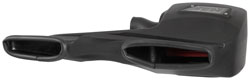
Relocating the engine's ECU allows for an additonal scoop to draw fresh air from oustide the veh

By doubling the area of the air intake AEM engineers feed the turbo a greater flow of air

This intake system is a revolutionary new design concept, which allows for the fully-assembled AEM replacement air box simply drop in place of the OEM Infiniti unit. Another innovation is the air filter axial seal. The filter is retained by a mounting bracket that is bolted tightly within the air box. This eliminates the need for clamps, for a tight, secure installation. The fully assembled air box then simply drops into the engine compartment which greatly simplifies the installation process.

The filter itself is an oversized AEM 21-1015DK Dryflow filter that uses an innovative high performance engineered material. Washable, non-woven synthetic filter medium chosen for its ability to deliver high air flow, excellent filtration, and improved performance. AEM Dryflow filters. In fact, a Dryflow filter captures up to 99% of harmful contaminants before they reach your engine.

While AEM Dryflow air filters typically do not require service until after about 100,000 miles (depending on driving conditions), a window is provided by which you can inspect the filter at any time. There’s an AEM logo burnished on the window so that when you raise the hood, that despite the OEM appearance of the system, it’s clear to anyone present

The AEM 21-820DS cold air intake is a relatively straightforward DIY modification that takes just a few hours to install, even for someone with little mechanical experience. Tools required are those that just about everyone has in their garage. The AEM 21-820DS utilizes only the factory mounting locations, so there are no holes to drill or permanent modifications to make.

Cleaning of the filter is straightforward and consists of an application of AEM 1-1000 synthetic air filter cleaner. The cleaner loosens and dissolves dirt and grime collected by the filter, after which the filter need only be rinsed with water, dried, and reinstalled.
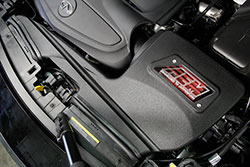
Only the AEM embossed window wil give away the additonal horsepowe gains the system provides

The AEM cold air intake kit for 2016-2017 QX30 is styled for an OEM-like appearance

You can purchase the AEM 21-807C Cold Air Intake factory direct for your 2016-2017 Infiniti QX30 here on the AEM site.

Innovation has always been AEM’s core competency, and the company continues to lead the way with innovative products that push the envelope of what is possible. That’s why you’ll find AEM filters under the hoods of many of the best racing teams and industry experts nationwide.

The AEM 21-820DS is designed to fit the following vehicles:

2017 INFINITI QX30 2.0L L4 Fuel Injection - All Models
2016 INFINITI QX30 2.0L L4 Fuel Injection - All Models

clear

AEM PRODUCT SEARCH     WHERE TO BUY AEM

Papadakis Racing, Piloted by Fredric Aasbo, Becomes Winningest Program in Formula D

Papadakis Racing team in winners circle at Formula Drift Montreal Photo by Larry Chen/Toyota Racing

The Papadakis Racing team celebrated Fredric Aasbo's 10th career win at Formula Drift Montreal

Stephan Papadakis’ involvement in drifting started as a side project while drag racing was his main profession. Initially starting as a driver, Papadakis shifted his role to team management and crew position after the 2007 season and has found success ever since. Current driver Fredric Aasbo’s recent win at the Formula Drift Montreal event made him the winningest driver in Formula Drift history, scoring his 10th event win since signing with the team in 2011 after earning rookie of the year honors as a privateer. Between both Aasbo and previous driver Tanner Foust, the team has amassed 17 event wins, 37 podium finishes, and 3 championships. Most impressively, the 10 event wins from Aasbo came in just 47 events with the team, averaging an event win for every 4.7 events entered. The previous single driver win record of 9 wins has stood since Sam Hubinette earned his last win back in 2007, although the record was tied by Vaughn Gittin Jr. halfway through the 2016 season.

Stephan Papadakis looks over suspension settings in the pits Photo by Larry Chen / Toyota Racing

Stephan Papadakis looks over suspension settings with Shawn Hillier and Mario Salguero

The current Toyota Corolla iM that Aasbo pilots is the eighth competition chassis that the team has built, with six of those chassis competing under the Papadakis Racing banner. Papadakis initially built a Nissan S13 chassis that he learned to drift in, before building a Nissan 350Z for Tanner Foust and a Honda S2000 that would later become Papadakis’s second personal drift car. The 350z would be piloted by Foust to the first and only back-to-back championships won by the same driver in 2007 and 2008. Foust would then move into a TRD-powered NASCAR engine Scion tC for the 2009 and 2010 series before Foust would move on to other motorsports and television ventures. Aasbo’s signing with the team in 2011 brought a new Scion tC2 chassis that was built by Papadakis Racing, which Aasbo piloted to the championship in 2015 and finished as the runner-up in the series championship in both 2014 and 2016. The Corolla iM was built fresh for the 2017 season after the Scion brand was sunsetted at the end of last season, and has earned two wins so far in the 2017 season through five events. Papadakis was also commissioned to build a Volkswagen Passat and a Scion FR-S for Foust and driver Jhonnattan Castro, which were campaigned away from the Papadakis Racing team in Formula Drift.

Stephan Papadakis evaluates maintenance options on the Corolla iM Photo by Larry Chen/Toyota Racing

Stephan Papadakis evaluates maintenance options on the Toyota Corolla iM with his team

The pairing of Papadakis and Aasbo has proven to be fruitful for both parties. Since Aasbo joined the team in 2011, the team has been using the 4-cylinder Toyota 2AR engine for both the Scion tC2 and Toyota Corolla iM chassis that have powered all 10 of Aasbo’s wins in the series. Papadakis Racing has long been known for their engine building prowess, carrying over from the days of import drag racing that started with a front-wheel drive Honda Civic before progressing to a full tube-chassis, rear-wheel drive car that Papadakis piloted to a best pass of 6.54 seconds at 255 mph in the ¼ mile. The current 2AR engine is the lone 4-cylinder engine on the current Formula Drift grid but keeps up with the 6-cylinder, 8-cylinder, and 10-cylinder cars that Aasbo lines up next to thanks to the 1,000 horsepower pushed through the turbocharged, nitrous-fed engine.

Although listed as the team owner and manager, Papadakis is still very heavily involved in the engine program as well as trackside wrenching. Papadakis has personally designed and prototyped several custom engine components and is constantly analyzing parts and data to look for opportunities to improve the power output. Papadakis also personally handles a lot of the logistics and operations for the team, ensuring that the team is ready for anything that is thrown their way on a race weekend. On a race weekend, it’s not unusual for Papadakis to be asked for the occasional autograph as well, dating back to his record-breaking Honda drag racing days, a rarity for a team owner and manager in the Formula Drift pits.

Papadakis still personally reviews data from runs in the Corolla iM Photo Larry Chen/Toyota Racing

Papadakis still personally reviews data from runs in the Toyota Corolla iM between rounds

Papadakis and Aasbo are both quick to credit the entire team for their success to date. Papadakis works alongside Shawn Hillier, Aldo Villagran, and Mario Salguero in the pits. On a race weekend, Papadakis is often found in the spotter’s tower communicating feedback from the judges and from his observations back to his driver Aasbo. Between rounds, Papadakis often reviews data logs from the car personally and discusses possible adjustments with the team. During competition, Shawn Hillier acts as crew chief with Mario Salguero helping with mechanical duties. Villagran has been working as a mechanic for Castro’s drift program this season, but still transports the car to each round and has been heavily involved in the program for the previous 10 seasons. Aasbo has racked up a slew of accomplishments with the Papadakis team behind him and is quick to credit the team with building one of the most powerful and most reliable cars he’s ever drifted as being a big part of why he’s now Formula Drift’s winningest driver in history.

Stephan Papadakis drag raced import cars in the early 2000s Photo by Larry Chen / Toyota Racing

Stephan Papadakis drag raced import cars in the early 2000s, but now is focused on his drift program

clear

AEM PRODUCT SEARCH     WHERE TO BUY AEM